
Paragliding in Nepal
-
Accommodation No
-
Duration 1
-
Trip Difficulty Beginner-friendly
-
Activities Adventure
-
Best Time pring (March–May) and autumn (September–November)
-
Max. Elevation Sarangkot launch point — approx. 1,592m
-
Group Size Min-1 Pax
-
Transportation Car / Flight
-
Start/End pokhara to pokhara
Overview
Pokhara is one of Nepal’s best-known paragliding destinations, and once you’re in the air, it’s obvious why. You launch from Sarangkot, a hilltop above the city, and within seconds a thermal picks you up and carries you out over Phewa Lake, with the Annapurna range and Machhapuchhre’s unmistakable fishtail peak filling the horizon. This isn’t a general “adventure activity” page — it’s specifically about the Sarangkot-to-Phewa-Lake tandem flight that makes Pokhara one of the best places on Earth to paraglide, and you don’t need any flying experience to do it. A certified pilot handles everything; you just take in the view.
Main Highlights
- Tandem paragliding flight launching from Sarangkot (1,592m)
- Himalayan views of Annapurna and Machhapuchhre from the air
- Aerial views of Phewa Lake and the wider Pokhara Valley
- A 20-30 minute scenic flight, weather and thermals permitting
- An experienced, certified tandem pilot flying with you the entire time
- No previous paragliding or flying experience required
- Hotel or city pickup and drop-off included
- Morning and afternoon flight time options
- Optional photo and video packages of your flight
What Makes Paragliding in Pokhara Special?
Flying Over Pokhara Valley Below you, Phewa Lake spreads out flat and reflective, with green hills, terraced farmland, and small villages surrounding it. The valley’s geography and daily thermal conditions are a big part of why Pokhara works so well for paragliding, helping pilots gain and maintain altitude without an engine.
Sarangkot Takeoff Sarangkot sits at roughly 1,592m, about a 20-30 minute drive above Pokhara’s lakeside area. Before takeoff, your pilot runs through a safety briefing and fits your harness. When conditions are right, you’ll take a few running steps toward the edge — and then the ground just isn’t there anymore.
Himalayan Mountain Views From altitude, the Annapurna massif dominates the skyline, with Machhapuchhre’s distinctive twin-pointed summit impossible to miss. Annapurna South, Dhaulagiri, Himchuli, and Lamjung Himal are all commonly visible too, weather depending.
The Tandem Experience You fly attached to a trained, certified pilot who controls the glider from launch to landing — you don’t need to know anything about flying beforehand. Your only job is to enjoy it, and maybe hold on a little tighter if your pilot works in a few turns.
What Does a Tandem Paragliding Flight Look Like?
Hotel pickup: a vehicle collects you from your Pokhara hotel or a central meeting point.
Drive to Sarangkot: roughly 20-30 minutes up to the launch site above the city.
Safety briefing: your pilot explains what to expect, how to position yourself for takeoff and landing, and answers any questions before you get fitted with your harness.
Equipment fitting: a proper harness check, connected securely to your pilot’s own gear.
Takeoff: a short run toward the edge of the hill, and then you’re airborne, climbing on the first thermal.
The flight: 20-30 minutes gliding above the valley, lake, and mountains, with your pilot managing altitude and direction the whole time.
Landing: a controlled descent to the landing zone near Phewa Lake, usually around Lakeside or Pame.
Return: a short transfer back to your hotel, often within half an hour of touching down.
What You’ll See During the Flight
- Phewa Lake, spread out below with mountains sometimes reflected on its surface
- The wider Pokhara Valley, with its patchwork of farmland and settlements
- Green hills and terraced fields
- Traditional villages dotted across the hillsides
- The Annapurna range, including Annapurna I and Annapurna South
- Machhapuchhre (Fishtail Mountain), instantly recognizable from the air
- Dhaulagiri, visible further along the horizon on clear days
Exactly which peaks you’ll see depends on the weather on the day — mountain visibility isn’t guaranteed on every flight, but autumn and spring generally offer the clearest conditions.
Safety and Equipment
Certified tandem pilots. Every flight is flown by a licensed, certified pilot with genuine tandem flying experience, not just a general paragliding qualification.
Pre-flight safety briefing. Every passenger gets a full briefing before takeoff, covering body position, what to expect during launch and landing, and basic safety information for the flight itself.
Harness and paragliding equipment. All gear meets international safety standards and is checked before every flight — this isn’t equipment that gets issued once and left unchecked.
Weather and flight conditions. Pilots assess wind and thermal conditions before every departure and will delay or reschedule a flight if conditions aren’t safe, rather than pushing ahead regardless.
Takeoff and landing. Both are the most controlled parts of the flight, with your pilot managing your position and timing throughout — you’re guided through each step, not left to figure it out yourself.
Who Is Paragliding in Nepal For?
- First-time flyers — no experience needed, your pilot does the actual flying
- Solo travelers — an easy, self-contained activity that doesn’t require a group
- Couples — a genuinely memorable shared experience, and a popular one for exactly that reason
- Families — suitable for a wide age range, subject to standard weight limits
- Adventure seekers — a real adrenaline moment at takeoff, followed by a genuinely peaceful flight
- Photographers and content creators — few vantage points in Nepal offer a view quite like this one
- Travelers wanting a short activity in Pokhara — the whole experience, door to door, usually takes under three hours
Paragliding vs. Other Adventure Activities in Pokhara
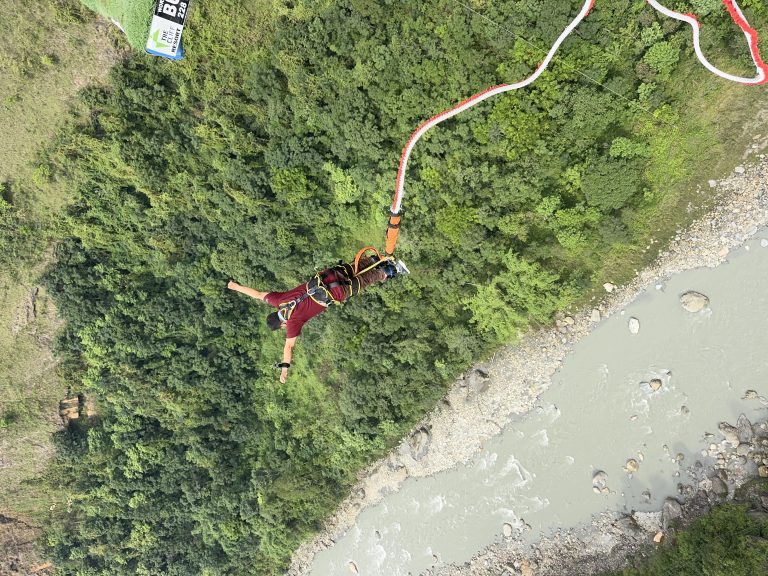
| Paragliding | Rafting | Bungee Jumping | |
|---|---|---|---|
| Type of experience | Aerial | River-based | Free-fall |
| Overall feel | Scenic and calm, with a thrilling launch | Active, water-based adventure | Short, intense adrenaline burst |
| Format | Tandem with a pilot | Group activity in one raft | Individual jump |
| Typical duration | 20-30 minutes | Usually a half-day or more | A few minutes, start to finish |
Each activity delivers a genuinely different kind of experience — paragliding is the one to choose if you want sweeping mountain views and a calmer, more scenic kind of adventure rather than pure adrenaline.
Best Time to Fly
Paragliding runs almost year-round in Pokhara, but autumn (September-November) and spring (March-May) offer the clearest skies and most reliable thermals. Late morning flights (around 11am) tend to catch stronger, more consistent thermals than very early morning flights, when the valley floor hasn’t warmed up enough yet. Flights are generally paused during the monsoon (June-August) when rain and unstable winds make conditions unsafe.
Outline Itinerary
Pickup from your Pokhara hotel → drive to Sarangkot (20-30 min) → safety briefing and harness fitting → takeoff and tandem flight (20-30 min) → landing near Phewa Lake → return transfer to your hotel.
Detailed Itinerary
Pickup and transfer to Sarangkot A vehicle collects you from your hotel or a central Pokhara meeting point for the short drive up to Sarangkot, the main paragliding launch site above the city.
Safety briefing and equipment fitting On arrival, your certified tandem pilot runs through a full safety briefing, then fits your harness and connects it securely to their own gear.
Takeoff When conditions are right, you'll take a few running steps toward the edge of the hill with your pilot — and then you're airborne, climbing on the first thermal above the valley.
The flight For the next 20-30 minutes, you'll glide above Phewa Lake, green hillsides, and small villages, with Machhapuchhre, Annapurna, and (on clear days) Dhaulagiri visible across the horizon. Your pilot manages the flight throughout, with the option to add gentle turns if you're up for it.
Landing A controlled descent brings you down at the landing zone near Phewa Lake, usually around Lakeside or Pame.
Return to Pokhara A short transfer takes you back to your hotel, often within half an hour of landing — plenty of time left in the day for anything else on your Pokhara itinerary.
Note: paragliding is entirely weather-dependent — flights can be delayed or rescheduled if wind or thermal conditions aren't safe on the day. Morning and afternoon slots are both generally available; ask your operator which suits your schedule best.
TripAdvisor Reviews
FAQs
No. The package is a tandem paragliding flight, so the pilot handles the glider. You only need to follow the pilot's instructions during takeoff and landing.
This package is based in Sarangkot, Pokhara, one of Nepal's best-known paragliding locations. The flight takes place above Pokhara Valley and Phewa Lake.
The scenic tandem flight generally lasts around 20–30 minutes, depending on weather and flying conditions.
On clear days, you can see Phewa Lake, Pokhara Valley, the Annapurna range, Machhapuchhre (Fishtail), and other Himalayan peaks.
Tandem paragliding is operated with an experienced pilot, safety briefing, harness equipment, and pre-flight checks. Flights are also dependent on suitable weather and wind conditions.
Paragliding depends heavily on wind, rain, clouds, and thermal conditions. If conditions are unsuitable, the flight may be delayed or rescheduled for safety.
Wear comfortable clothing and secure, closed footwear. Sunglasses and sunscreen are also useful, while a light jacket can be helpful depending on the weather.
Children may be able to participate depending on the operator's age, weight, and safety requirements. Confirm the applicable requirements before booking.
Yes, optional photo and video packages are available for the flight, subject to the package/operator arrangement.
The package includes pickup from your Pokhara hotel or a designated meeting point, followed by transport to the Sarangkot launch site.
The tandem flight normally lands in the Pokhara/Phewa Lake area, after which you can take the return transfer to your hotel.
Spring (March–May) and autumn (September–November) generally offer favorable visibility and flying conditions. However, the actual flight depends on the weather on the day.