


Tsum Valley Trek
US $$1,099

Most people who trek in the Annapurna region end up on the same handful of trails — Poon Hill, Annapurna Base Camp, maybe Mardi Himal. Khopra Danda is the quieter option most of them never hear about: a high ridge with one of the widest mountain panoramas in Nepal, and a sacred glacial lake that pilgrims have been climbing to for generations. You get essentially the same Himalayan scale as Annapurna Base Camp, minus the crowds.
The trail climbs northwest of Pokhara through the Annapurna Conservation Area, from terraced farmland and rhododendron forest up to Khopra Ridge (3,660m) — a viewpoint locals and guides often rate above even Poon Hill for its sheer width of view. From there, a demanding day hike takes you up to Khayer Lake (4,660m), a small, sacred alpine lake tucked beneath Annapurna South. The whole route runs through community-managed lodges rather than privately-owned teahouses, meaning the money you spend on the trail goes directly back into the villages you’re walking through.
This trek suits a broad range of people, including:
Both treks sit inside the Annapurna Conservation Area, but they deliver genuinely different experiences.
Khopra Danda is quieter, runs almost entirely on a community-managed trail, and spends real time walking along an open ridge rather than climbing into a valley. Fewer teahouses means less infrastructure, but also fewer people — and it adds a genuine pilgrimage destination in Khayer Lake that ABC doesn’t have an equivalent to.
Annapurna Base Camp takes you into the Annapurna Sanctuary itself, right up against glaciers and the base of Annapurna I — a genuinely iconic destination, but one that sees far more foot traffic and commercial infrastructure as a result.
Choose Khopra if solitude, culture, and a community-supported trail matter most to you. Choose ABC if standing inside the Annapurna circuit itself is the specific goal.
Khayer Lake is sacred to both Hindus and Buddhists, and it’s genuinely treated as a pilgrimage site, not just a pretty stop on a trekking itinerary. The lake is dedicated to the goddess Khayer Barahi, and a small shrine sits on its shore where visitors — trekkers and pilgrims alike — leave flowers and offerings. Local pilgrims climb here for an annual ritual bath, believed to bring good fortune and, in some local traditions, to help toward achieving spiritual liberation. Sitting at 4,660m beneath Annapurna South, with snow peaks reflected in the still water on a clear day, it’s easy to understand why this specific spot has held that kind of meaning for so long.
Beyond Ghorepani, this route switches onto a community-managed trail system — a genuinely different model from the privately-run teahouses found on Nepal’s busier routes. Local committees manage the lodges, and the income generated goes back into the villages themselves, supporting local schools and healthcare rather than outside investors. Educator and social activist Mahabir Pun, known across Nepal for his rural connectivity and development work, has been closely involved in promoting this trail since it opened, helping turn it into a working example of community-based tourism. You’ll pass through forest, open meadow, and genuine wildlife habitat along the way, all managed under this same local model — walking here supports conservation and rural development directly, not just abstractly.
This is the trek’s signature moment. Khopra Ridge sits at 3,660m, on a genuine ridgeline between the Kali Gandaki Gorge and the Annapurna massif, and the view from here is about as wide as mountain panoramas get in Nepal. On a clear day, you’ll see Dhaulagiri (8,167m), Annapurna South, Nilgiri, Fang, and Tukuche Peak, often all at once, without a single ridge or valley wall blocking any of it. Sunrise and sunset here are genuinely worth staying an extra night for — the light moves across the whole range in a way that’s hard to properly describe until you’ve seen it happen.
Khopra Ridge alone justifies bringing a proper camera. Beyond the ridge panorama itself, expect strong opportunities for sunrise shots over Dhaulagiri, a genuinely dark sky for night photography (the Milky Way is clearly visible on clear nights, far from any real light pollution), rhododendron forest in full bloom if you’re trekking in spring, everyday village life in Gurung and Magar settlements, and still-water reflections of snow peaks at Khayer Lake itself on calm mornings.
Mornings start with breakfast in a community lodge, usually with local, organically-sourced food rather than imported trekking staples. Most days involve a steady climb through forest — rhododendron lower down, thinning into more open terrain higher up — with regular stops for the kind of views that don’t really show up until you’re on a ridge like this one. Villages along the way, like Swanta and Chistibang, offer genuine chances to talk with local Gurung and Magar families rather than just pass through. Evenings settle into a simple routine: a hot meal, conversation with other trekkers and your guide, and an early night, especially before the long push to Khayer Lake.
This trek is moderate, suitable for both first-timers with reasonable fitness and more experienced trekkers. Daily walking runs 5-7 hours, with the round trip to Khayer Lake being the hardest single day — steep, rocky, and exposed in places, though not technical.
Altitude. You’ll reach 4,660m at Khayer Lake, with real effects from thin air above 4,000m. You’ll sleep back at the Khopra Ridge lodge (3,660m) rather than near the lake itself, which keeps your net overnight altitude gain safer.
Permits. You’ll need an Annapurna Conservation Area Permit (ACAP) and a licensed guide, both arranged as part of your booking.
Best time to go. Spring (March-May) for rhododendron blooms, or autumn (September-November) for the clearest mountain views.
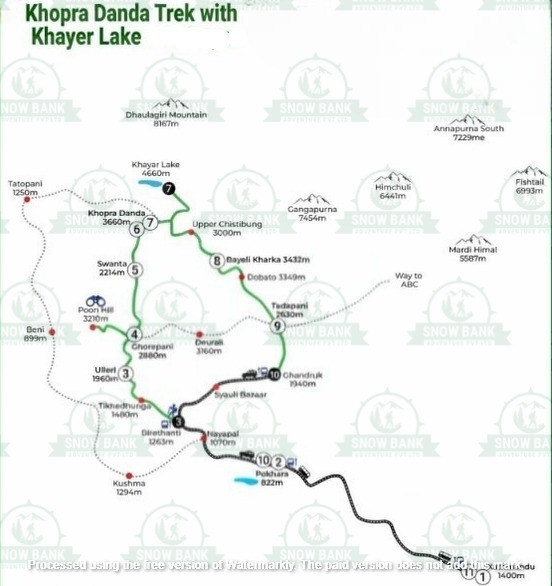
Day 1: Arrival in Kathmandu (1,400m)
Day 2: Drive from Kathmandu to Pokhara (822m)
Day 3: Drive from Pokhara to Birethanti (1,263m), trek to Ulleri (1,960m)
Day 4: Trek from Ulleri to Ghorepani (2,874m)
Day 5: Trek from Ghorepani to Swanta (2,214m)
Day 6: Trek from Swanta to Khopra Danda (3,660m)
Day 7: Trek from Khopra Danda to Khayer Lake (4,660m), return to Khopra
Day 8: Trek from Khopra Ridge to Bayeli (3,432m)
Day 9: Trek from Bayeli to Tadapani (2,630m)
Day 10: Trek from Tadapani to Ghandruk (1,940m), drive to Pokhara (822m)
Day 11: Drive from Pokhara to Kathmandu (1,400m) Day 12: Final departure
Day 1: Arrive in Kathmandu (1,400m)
Land at Tribhuvan International Airport, where you'll be met and transferred to your hotel.
Day 2: Drive from Kathmandu to Pokhara (822m)
A scenic road journey west, with the lakeside city of Pokhara as your base before heading into the mountains.
Day 3: Drive from Pokhara to Birethanti (1,263m), trek to Ulleri (1,960m)
A drive to the trailhead, then a walk along the river through Tikhedhunga before the famous climb up more than 3,000 stone steps into Ulleri — a proper first test for your legs, with early Annapurna views as a reward.
Day 4: Trek from Ulleri to Ghorepani (2,874m)
A steady climb through rhododendron and oak forest into Ghorepani — a village whose name literally means "horse water," a legacy of its old role as a rest stop on the Tibet-India salt trade route.
Day 5: Trek from Ghorepani to Swanta (2,214m)
Here the route leaves the busier Poon Hill trail behind, descending through forest into Swanta, a quieter Magar village and your entry point into community-managed lodge territory.
Day 6: Trek from Swanta to Khopra Danda (3,660m)
A steady climb above the treeline to Khopra Ridge. Arriving by early afternoon leaves time to properly take in the sunset over Dhaulagiri from the community lodge.
Day 7: Trek from Khopra Danda to Khayer Lake (4,660m), return to Khopra
The trek's hardest and most rewarding day — a long, steep round trip to the sacred lake and back, roughly 8-9 hours total. The lake itself, ringed by snow peaks and marked by a small shrine to the goddess Khayer Barahi, makes the effort worthwhile.
Day 8: Trek from Khopra Ridge to Bayeli (3,432m)
A descent into deep, mixed rhododendron forest, a noticeable shift from the open ridge terrain of the past two days.
Day 9: Trek from Bayeli to Tadapani (2,630m)
Continuing through forest, rejoining terrain more familiar from the classic Poon Hill and Annapurna Base Camp routes.
Day 10: Trek from Tadapani to Ghandruk (1,940m), drive to Pokhara (822m)
A descent through forest into Ghandruk, one of the larger Gurung villages in the region, followed by a drive back to Pokhara.
Day 11: Drive from Pokhara to Kathmandu (1,400m)
A scenic road journey back to the capital, closing out the trekking portion of the trip.
Day 12: Final departure
Transfer to the airport for your international flight home.
Note: trail conditions and daily pace can shift slightly depending on weather and season — your guide will confirm the exact plan day to day.
The trek is rated moderate. Most trekking days involve 5–7 hours of walking on well-established trails. The hike to Khayer Lake (4,660m) is the most demanding section because of the steep ascent and higher altitude, but no technical climbing is required.
The highest point is Khayer Lake at 4,660 meters (15,289 ft). The main overnight stop at Khopra Ridge (3,660m) allows gradual acclimatization before the day hike to the lake.
There is a moderate risk because the trek reaches above 4,500 meters. The itinerary is designed with gradual elevation gain, and you return to sleep at a lower altitude after visiting Khayer Lake. Drinking plenty of water and walking at a steady pace help reduce the risk.
You'll need an Annapurna Conservation Area Permit (ACAP). A licensed guide is also required under Nepal's current trekking regulations. Snowbank Adventure arranges all necessary permits before the trek begins.
The best seasons are spring (March–May) and autumn (September–November). Spring brings colorful rhododendron forests, while autumn offers the clearest mountain views and stable weather.
Khayer Lake is an important pilgrimage site for both Hindus and Buddhists. It is dedicated to Khayer Barahi, and local pilgrims visit the lake for religious ceremonies, especially during the annual Janai Purnima festival.
While Annapurna Base Camp takes you into the Annapurna Sanctuary, Khopra Danda offers quieter trails, community-managed lodges, and panoramic ridge views with far fewer trekkers. It's ideal for travelers looking for a more peaceful trekking experience.
Accommodation is in comfortable community lodges and teahouses with twin-sharing rooms. Facilities are simple but clean, and most lodges provide hot meals, warm dining areas, and basic amenities.
On clear days you'll enjoy spectacular views of Dhaulagiri (8,167m), Annapurna South, Nilgiri, Machhapuchhre (Fishtail), Fang Peak, Tukuche Peak, and several surrounding Himalayan peaks.10. Is this trek suitable for beginners?
Yes. Trekkers with a reasonable level of fitness can complete the trek successfully. Although the hike to Khayer Lake is challenging, the overall itinerary is suitable for motivated first-time trekkers with proper preparation.