
Langtang Valley Trek

5.0 from 08 reviews
  • Accommodation 4-Star Hotel in Kathmandu/Tea House during Trek
  • Duration 08
  • Trip Difficulty Moderate
  • Activities Trekking
  • Best Time Spring and Autumn
  • Max. Elevation Tserko Ri (5000m/16,404ft
  • Group Size Min-02 pax
  • Transportation Car/Jeep
  • Start/End Syabrubensi to Syabrubensi

Overview

The Langtang Valley Trek is the closest Himalayan trekking destination to Kathmandu, the capital of Nepal, making it the perfect gateway to the high-altitude Himalayan experience without the long travel distances. Despite being just a few hours from the city, the Langtang Valley trek rivals any highland trek in Nepal for sheer natural beauty, cultural richness, and breathtaking mountain panoramas.

Whether you are a first-time trekker or a seasoned hiker, the Langtang Valley trek offers an exceptional blend of tranquil rural terrain, traditional villages, unique Tamang culture, and warm-hearted local hospitality — all within a compact, manageable route.

Why Choose the Langtang Valley Trek?

The Langtang Valley trek is one of the most diverse trekking routes in Nepal. Here’s why thousands of trekkers choose it every year:

  • Proximity to Kathmandu — Just 7–8 hours by road, no flights required
  • Stunning Natural Scenery — Blooming rhododendron forests, bamboo groves, cascading waterfalls, and dramatic mountain vistas
  • Rich Cultural Immersion—Explore the unique traditions of the native Tamang people, whose customs closely resemble Tibetan culture
  • Flexible Trekking Routes — A series of broad valleys offering multiple route options to suit all fitness levels
  • UNESCO-listed Biodiversity — The region is home to Langtang National Park, Nepal’s first Himalayan national park, established in 1971

The Langtang Region was nominated as Nepal’s first Himalayan national park in 1971, as it comprises the Himalayan feel with the habitation of the native Tamang people, whose religion, culture, traditions, and norms are much more likely to be those of Tibetans than of their cousins in the hills.

The Langtang Valley trek strolls along the fast-flowing Trisuli River, north of the capital of the country, Kathmandu. With a groovy bus ride rewarding us with the enchanting beauty of the diversified flora and fauna, we make our way through the trail of the cascading waterfalls and dense forest along the way, ultimately to the fluttering Trisuli Bazaar, transporting us to the beautiful village of Dhunche and later Syabrubensi.

Thereupon, the trek strolls into the Langtang Valley on the foot trail up along a gorge-like lower section of the valley. The Langtang Valley trek continues via the hostile moraine trail to the Tibetan village of Langtang, where you will be enthralled by the beauty of the various Tibetan festivities as you participate in them as one of the natives. The locals of the region will please your heart with their broad-hearted, warm hospitality, with the motto

‘Aathiti Devo Vawa,’ which means that the guest is God.

Following the route of the Langtang Valley Trek, we reach Kyanjin Gompa (Monastery), a Buddhist sanctuary preserving the tranquility of Buddhism. The Langtang Valley Trek acclimatizes at the Kyangin Gompa to sample the local yak cheese, which is one of the best cheeses available in the whole wide world. We make our way via the Nubamatang, located in the hidden valley of the gateway to Tibet.

Backtracking, we travel through Syabru and Sing Gompa, where the sanctified lake Gosainkund is located. The holy tranquility of the Gosaikunda Lake is believed to wash away all your sins and offer you a new life to do well and be good. Crossing the Laurebena Pass, we continue south, leaving the Langtang region behind us as we travel through the Helambu Valley to Gul Bhanjyang. From here, the Langtang Valley Trek comes to a halt with a few days’ journey back to Kathmandu.

Best Time to Trek Langtang Valley

The Langtang Valley trek can be done year-round, but the ideal seasons are the following:

Spring (March–May): Rhododendrons in full bloom, clear skies, warm temperatures

Autumn (September–November): Crisp air, excellent mountain visibility, festive atmosphere

Outline Itinerary

Day 01: Arrival at TIA Kathmandu (1,300 m/4,265 ft)

Day 02: Kathmandu to Syabrubesi (1,550m/5,100ft): 7-8 hours

Day 03: Syabrubesi to Lama Hotel (2,380m/7,830ft): 5-6 hours

Day 04: Trek to Mundu (3,543 m/11,621 ft) through Langtang village: 6-7 hours

Day 05: Mundu to Kyangjin Gompa (3,870m/12,697ft): 4-5 hours

Day 06: Acclimatization in Kyangjin Gompa and Explore Tserko Ri (5000 m / 16,404 ft) 6-7 hours

Day 07: Kyangjin Gompa to Lama Hotel: 5-6 hours

Day 08: Lama Hotel to Syabrubesi: 4-5 hours

Day 09: Syabrubesi to Kathmandu

Day 10: Final Departure
Detailed Itinerary

After arriving in Kathmandu, a delegate from Snow Bank Adventure will pick you up and take you to your hotel. At night, there will be an appreciated supper hosted by Snow Bank Adventure.
  • Accommodation: Overnight at Star Hotel
  • Meals: D
We leave Kathmandu in the first part of the day for Syabrubesi, a town that is likewise the beginning stage for treks into the Langtang valley. Our voyage will be on a twisting street through regular curves. On a crisp morning, we get the chance to appreciate exceptional perspectives on Manaslu, Annapurna, and Ganesh Himal. Our trek, for now, finishes with a plummet into the little town of Syabrubesi.
  • Accommodation: Overnight at the tea house
  • Meals: B L D
After breakfast, we start our trek to Syabrubesi along the Langtang Khola. We rise and slip all the while through oak and rhododendron timberlands. In the wake of traverse the Langtang Khola (little stream), we rise on a lofty trail that will lead us to the Lama Hotel.
  • Accommodation: Overnight at Tea house
  • Meals: B L D
We keep rising from the Lama Hotel and appreciate the mountain scene with rich cascades. As we achieve the green knolls of Ghoda Tabela, we start to see the white pinnacles of the Langtang extend. Our trail keeps on scaling the extending valley, passing a couple of brief settlements utilized by herders. We pass a Buddhist cloister before achieving the Langtang town which was influenced by the April 2015 tremor. We proceed on our trail to Mundu. Accommodation: Overnight at Tea house Meals: B L D
After breakfast, we will begin our voyage to Kyangjin Gompa, a primary cloister of the locale. We go by water factories, supplication wheels, chortens, with hallowed hills of rocks with engravings cut on them. We likewise go by the biggest mani divider in Nepal, produced using stone with supplications composed on them. After the short trek, we spend the remainder of the evening investigating the Buddhist holy place in Kyangjin Gompa and encompassing zones with stunning perspectives on the mountains. Accommodation: Overnight at tea house Meals: B L D
We spend the entire day investigating Tserko Ri which will likewise enable us to adapt to the high elevation. We start promptly in the first part of the day. The dawn sees from the highest point of Tserko Ri is phenomenal. We return to Kyangjin Gompa by late evening and investigate the delightful cloister while getting a charge out of perspectives on the Himalayas, icy masses, feathered creatures, and yaks.
  • Accommodation: Overnight at tea house
  • Meals: B L D
We start our trek after breakfast and backtrack our means to Lama Hotel. A large portion of the trekking today will be downhill as we go through woodlands and wonderful Tamang towns. We likewise get the chance to appreciate a distinctive perspective on the Himalayas that we had missed moving up.
  • Accommodation: Overnight at tea house
  • Meals: B L D
We stroll back to Syabrubesi. The trek will be simpler as it will for the most part include descending. We spend the night celebrating our successful Langtang Valley Trek.
  • Accommodation: Overnight at tea house
  • Meals: B L D
After breakfast, we drive back to Kathmandu. We spend the remainder of the day pressing and possibly making up for lost time with some very late trinket shopping. Snow Bank Adventure will commend our effective excursion in the Langtang Valley by facilitating a goodbye supper.
  • Accommodation: Overnight at tea house
  • Meals: B L D
Our adventure in Nepal is coming to an end today! A Snow Bank Adventure delegate will drop you off at the airport roughly 3 hours before your booked flight. On our approach to home, you will have a lot of time to design your next experience in the magnificent nation of Nepal.
  • Accommodation:
  • Meals: B

Includes & Excludes

Includes

  • Airport (Pickup, Drop) Transportation
  • Farewell dinner
  • Accommodation: 2 nights in Kathmandu, Bed and breakfast
  • Transportation from the starting  and ending points of trekking by private vehicle
  • Three meals and tea or coffee during the trek
  • Safe drinking water (treated with chlorine and iodine)
  • Permit for the trek (TIMS, Conservation, and National park fee)
  • All types of necessary government  paperwork and government taxes
  • Guide and Porter (meals, wages, insurance, and transportation)
  • An English-speaking government-registered trekking guide and porter(1 porter for 2 trekkers)
  • Trekking equipment like a raincoat, sleeping bag, down jacket, and walking pole

Excludes

  • Personal expenses
  •  Personal & medical insurance
  •  Rescue evacuation by Helicopter in an emergency case
  • Beverage and bar bills (soft drinks, hard drinks, and mineral water)
  • Boiled water
  •  Lunch & Dinner in Kathmandu, except for the farewell dinner
  • Electronic device recharge
  • Wi-fi during the trek
  • Tips for Guide and Porter

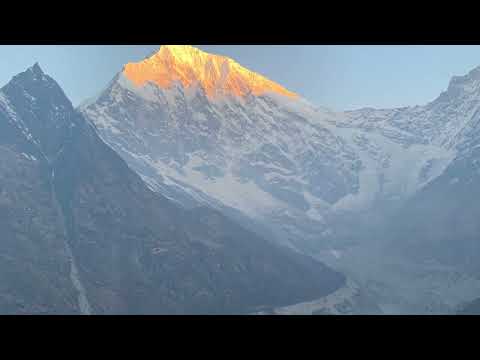
Trek Video

Trip video preview

Packing List

Langtang Valley Main Trekking Gear Duffel Bag (25 kg): This will be arranged by us. After you reach Kathmandu, you should move your belongings into this bag before beginning the Langtang trek. The porters will be responsible for carrying it along the journey. Meanwhile, your suitcase remains securely stored at the hotel Daypack (25 to 30 liters): You'll carry this every day; it should hold your most frequently used items, snacks, and any personal belongings you want during the walk. Sleeping Bag (rated to -15°C to -20°C): Provided for you. Nights get cold, especially in Kyanjin, Tsergo Ri and higher sections. You can use this every night. Down Jacket: This is provided for you. It helps keep your body warm during cold times like early morning, rest breaks, and after sunset. Trekking Poles: These are useful while walking on steep uphill and downhill paths. They also reduce pressure on your knees. Water Bottle/Refillable System: Carry a bottle of about 1-2 liters. You can refill it during the trek from natural water sources or village taps. Water Purification Tablets: We provide these tablets. They are easy to use and help make drinking water safe. Headlamp with Extra Batteries: Important for early morning hikes and in places with low light or power cuts. Travel Adapter: Nepal uses different plug types, so it is better to bring a universal adapter for charging devices. Day Bags/Zip Locks: These help separate your items and protect clothes, electronics, and documents from rain or moisture.

FAQs

Yes! The Langtang Valley trek is rated moderate and is ideal for beginners with a reasonable fitness level. Most trails are well-marked with teahouse accommodation along the route.
Yes. Trekkers need a TIMS card and a Langtang National Park entry permit.
You can take a public bus or private jeep from Kathmandu to Syabrubensi (approx. 7–8 hours).
The Langtang Valley Trek is a soul-stirring journey that combines Himalayan grandeur with cultural depth—all just a day's drive from Kathmandu. Whether you're chasing mountain views, spiritual experiences, or authentic village life, Langtang has it all.