


Nar Phu Valley with Tilicho Lake
-
Accommodation Hotel and Teahouse
-
Duration 16
-
Trip Difficulty Strenuous
-
Activities Trekking
-
Best Time Sept, Oct, Nov, Apr, May, and June
-
Max. Elevation 5,320m
-
Group Size Min-02 pax
-
Transportation Bus, Car & Flight
-
Meals B L D During Trek
-
Start/End Kathmandu to Kathmandu
Overview
Most Annapurna Circuit trekkers cross one pass and call it a trip. This route asks for three. You’ll leave the main circuit at Koto and disappear into Nar and Phu — restricted, Tibetan-influenced valleys that stayed closed to outside visitors for years and still feel like it — before crossing Kang La Pass back toward Manang. From there, a detour to Tilicho Lake, one of the highest lakes in the world, adds a turquoise, glacier-fed centerpiece to the trip before you finish with the classic, demanding crossing of Thorong La and a descent into Muktinath.
What makes this route different is combining all three: the restricted culture of Nar Phu, the remote physical test of Kang La, and the famous high-altitude crossing of Thorong La, in one continuous 16-day trek. It’s a genuinely more adventurous alternative to the standard Annapurna Circuit — not a replacement for it, but the harder, deeper version of the same region.
Main Highlights
- Nar Phu Valley and its traditional villages — stone houses, restricted-area status, and a way of life that’s changed slowly.
- Tibetan Buddhist culture and monasteries — active religious sites throughout the valley, not preserved for show.
- Kang La Pass (5,322m) — the trek’s first serious physical test.
- Tilicho Lake (around 4,919m) — a turquoise, high-altitude lake among the highest of its kind anywhere.
- Thorong La (5,416m) — one of the highest trekking passes in the world, and the trek’s final major crossing.
- Views of Annapurna, Gangapurna, Tilicho Peak, and Himlung Himal — across multiple viewpoints on the route.
- A landscape that keeps changing — forest, high alpine terrain, and finally the dry desert country around Mustang.
- Muktinath, one of the most religiously significant sites in the Himalayas, waiting at the end of the trek.
What Makes This Trek Special?
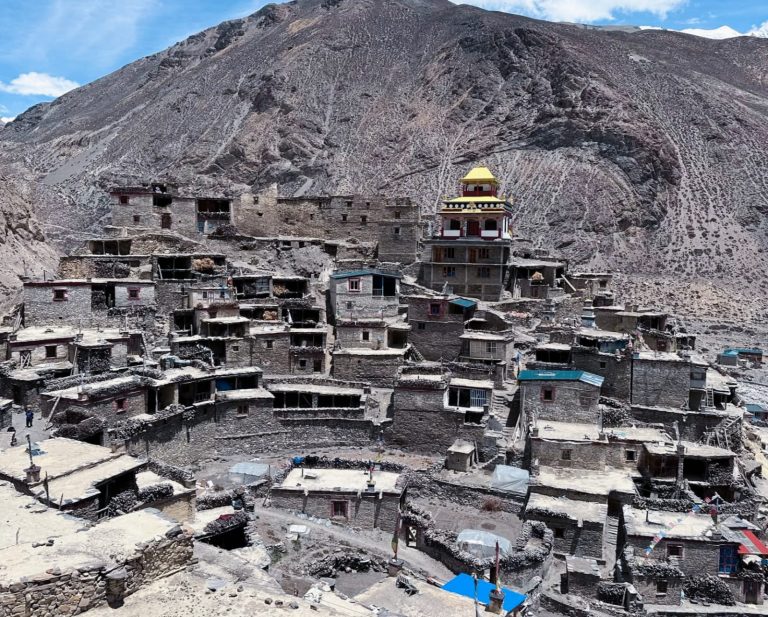
Nar Phu Valley — The Hidden Side of Annapurna Nar Phu only opened to foreign trekkers in 2003, and its restricted-area status has kept large-scale tourism out ever since. Phu Gaon is a walled village of stone houses built into the hillside, with an ancient monastery watching over it; Nar has its own distinct character a short distance away. Chortens, mani walls, and prayer flags mark the trail throughout, and the pace of daily life here feels genuinely different from the busier stretches of the main Annapurna Circuit.
Kang La Pass — The First Major Crossing At 5,322m, Kang La is a serious physical test early in the trek. The climb is steep and sustained, so you’ll leave before dawn to cross while conditions are calmest. From the top, expect wide views over Annapurna II, Gangapurna, Tilicho Peak, and Himlung Himal, before a long descent down toward Ngawal and the Manang side of the Annapurna Circuit.
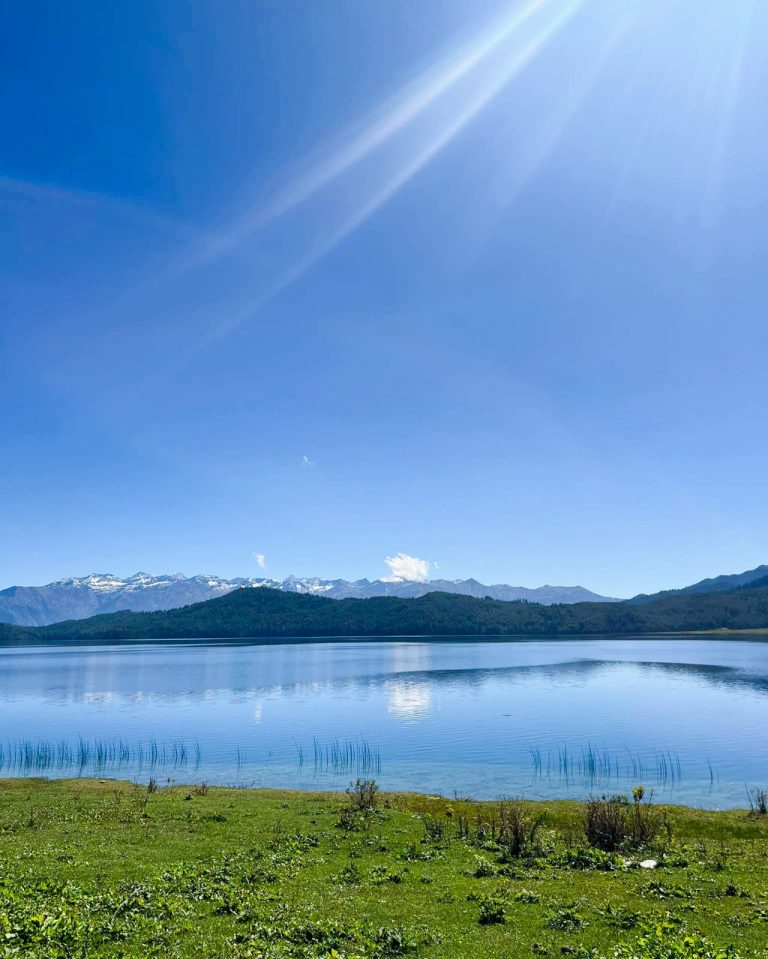
Tilicho Lake — The High-Altitude Detour At roughly 4,919m, Tilicho is one of the highest lakes of its size anywhere in the world, ringed by Tilicho Peak and the wider Annapurna massif. Most trekkers base at Tilicho Base Camp and hike to the lake and back in a single early morning, taking in the turquoise, glacier-fed water before returning to camp. It’s a genuinely different kind of payoff from a mountain pass — quiet, still, and visually unlike anything else on the route.
Thorong La — The Final Big Test At 5,416m, Thorong La is one of the highest trekking passes in the world, and by the time you reach it, you’ll already have Kang La and Tilicho behind you — which makes this crossing feel different from doing it on the standard circuit alone. The ascent from the Manang side is long, and most trekkers start in the dark to reach the top before the wind picks up. Prayer flags mark the summit, with a genuinely wide mountain panorama in every direction, before a long descent into Muktinath — one of the most sacred pilgrimage sites in the Himalayas for both Hindus and Buddhists. Crossing Thorong La on top of everything that came before it is exactly what makes this itinerary significantly more demanding than either a standard circuit trek or a standalone Nar Phu trip.
Nar Phu Culture and Tibetan Buddhist Heritage
Phu Gaon and Nar are the cultural core of this trek, and it’s worth being specific about what you’ll actually see there, not just that the culture is “preserved.” In Phu Gaon, stone houses are stacked tightly into the hillside, with a centuries-old monastery still functioning as a genuine center of daily worship. Nar carries its own distinct identity a short walk away, with its own monasteries and mani walls. Throughout the valley, chortens mark trail junctions and village entrances, prayer flags snap in the wind at every high point, and the Tibetan-influenced architecture — flat roofs, whitewashed stone, small windows built against the cold — reflects centuries of contact with Tibet rather than the rest of Nepal. Because Nar Phu’s restricted-area status has kept large-scale tourism out, daily life here — farming, herding, religious practice — has continued largely on its own terms rather than being reshaped around visitors.
Who Is This Trek For?
This trek is best suited to:
- Experienced trekkers who’ve already completed at least one demanding high-altitude route
- People comfortable with sustained time above 5,000m — this trek includes two separate passes at that height
- Trekkers with genuinely good physical fitness, given the combination of distance, altitude, and consecutive demanding days
- Adventure travelers looking for more than the standard circuit offers
- Trekkers who want culture and high passes together, not just one or the other
- People comfortable with basic teahouse accommodation, particularly in the Nar Phu section, where facilities are simpler than on the main circuit
This is not recommended as a first high-altitude trek. If you’re new to trekking at altitude, a shorter, single-pass route is a better place to start.
Nar Phu with Tilicho Lake vs. the Standard Annapurna Circuit
| This Trek | Standard Circuit | |
|---|---|---|
| Nar Phu Valley | Yes | No |
| Kang La Pass | Yes | No |
| Tilicho Lake | Yes | Optional side trip |
| Thorong La | Yes | Yes |
| Restricted area | Yes | No |
| Difficulty | Higher | Moderate to strenuous |
| Cultural experience | Strong, and less commercialized | Strong, but more established |
| Crowds | Lower, especially in Nar Phu | More established, busier trail |
If you want the classic Annapurna Circuit experience with a well-worn trail and the option to add Tilicho as a side trip, the standard circuit delivers that well. If you want the restricted Nar Phu valley, a second major pass in Kang La, and a guaranteed stop at Tilicho Lake, all combined with the classic Thorong La finish, this itinerary is built for exactly that.
A Day in the Life
Mornings in Nar Phu start cold, with frost on the teahouse window and a hot breakfast before the day’s climb. The trail moves through narrow gorges, over high suspension bridges, and past villages that feel genuinely earned rather than just passed through. Once you’re back on the main circuit side, near Manang and Tilicho, the rhythm shifts — busier trail, more established teahouses, and a different kind of energy as more trekkers share the route. On both Kang La and Thorong La days, the pattern is the same: a pre-dawn start, hours of steady, deliberate climbing, and real relief once the pass is behind you. Evenings vary by location, but the routine holds throughout — a hot meal, conversation about the next day’s terrain, and an early night before whatever comes next.
Trek Difficulty & Permits
Daily walking runs 3-7 hours, with the Kang La and Thorong La crossings being the two longest, hardest days on the route.
Altitude. You’ll cross Kang La at 5,322m and Thorong La at 5,416m, with Tilicho Lake itself at around 4,919m in between. Acclimatization days are built in at Phu Gaon and Manang — don’t skip them, especially given how much time this itinerary spends above 4,500m.
Permits. You’ll need a Nar Phu restricted-area permit, an Annapurna Conservation Area Permit (ACAP), and a licensed guide, all arranged as part of your booking. As of March 2026, Nepal removed the rule requiring a minimum of two trekkers for restricted-area permits, so solo travelers can join with just a guide.
Best time to go. Spring (March-May) and autumn (September-November) offer the most stable weather for all three major crossings on this route.
Outline Itinerary
Day 1: Drive from Kathmandu via Besisahar to Taal (1,700m)
Day 2: Trek from Taal to Koto (2,600m) — 5-6 hrs
Day 3: Trek from Koto to Meta (3,570m) — 7 hrs
Day 4: Trek from Meta to Phu Village (4,080m) — 6 hrs
Day 5: Acclimatization day in Phu Village (4,080m)
Day 6: Trek from Phu Village to Nar Village (4,100m) — 6-7 hrs
Day 7: Cross Kang La Pass (5,322m), trek to Ngawal — 7 hrs
Day 8: Trek from Ngawal to Manang (3,540m) — 3-4 hrs
Day 9: Acclimatization day in Manang (3,540m)
Day 10: Trek from Manang to Tilicho Base Camp (4,150m) — 5-6 hrs
Day 11: Hike to Tilicho Lake (4,919m), return to Base Camp — 5-6 hrs
Day 12: Trek from Tilicho Base Camp to Yak Kharka (4,060m)
Day 13: Trek from Yak Kharka to Thorong Phedi (4,525m)
Day 14: Cross Thorong La Pass (5,416m), trek to Muktinath (3,760m)
Day 15: Drive to Jomsom, fly to Pokhara
Day 16: Drive from Pokhara to Kathmandu — 7 hrs, approx. 200km
Detailed Itinerary
Day 1: Drive from Kathmandu via Besisahar to Taal (1,700m) A long drive west out of Kathmandu, following the Marsyangdi River valley up into the mountains and onto the Annapurna Circuit trail, ending at the small village of Taal.
Day 2: Trek from Taal to Koto (2,600m) — 5-6 hrs A relatively straightforward day on the main circuit trail. Koto is where you'll leave the busy Annapurna Circuit behind and turn into the restricted Nar Phu valley.
Day 3: Trek from Koto to Meta (3,570m) — 7 hrs The trail narrows into a steep, dramatic gorge along the Nar Phu River, crossing high suspension bridges as the valley closes in and the crowds thin out completely.
Day 4: Trek from Meta to Phu Village (4,080m) — 6 hrs The trail climbs steadily through increasingly remote terrain, passing ruined forts and chortens before reaching Phu, a walled village that feels like it belongs to another century.
Day 5: Acclimatization day in Phu Village (4,080m) A rest day to properly adjust to the altitude, with time to explore the village and its ancient monastery.
Day 6: Trek from Phu Village to Nar Village (4,100m) — 6-7 hrs A descent back down the valley followed by a climb into Nar, a village with good views of Pisang Peak and its own distinct character from Phu.
Day 7: Cross Kang La Pass (5,322m), trek to Ngawal — 7 hrs The trek's first major test. An early start gets you over Kang La, with views of Annapurna II, Gangapurna, Tilicho Peak, and Himlung Himal from the top, before a long descent back onto the main Annapurna Circuit at Ngawal.
Day 8: Trek from Ngawal to Manang (3,540m) — 3-4 hrs An easier day on the well-established circuit trail, arriving in Manang, a noticeably livelier stop known for its bakeries as much as its mountain views.
Day 9: Acclimatization day in Manang (3,540m) A rest day before the Tilicho detour, with optional short hikes above the village for extra acclimatization.
Day 10: Trek from Manang to Tilicho Base Camp (4,150m) — 5-6 hrs Leaving the main circuit trail again, the route crosses an exposed slope above the Khangsar valley before reaching Tilicho Base Camp — a demanding day that covers significant ground, so pace yourself and stay alert to changing weather.
Day 11: Hike to Tilicho Lake (4,919m), return to Base Camp — 5-6 hrs An early climb to the lake itself, with Tilicho Peak rising directly above the turquoise water, before returning to base camp for the night.
Day 12: Trek from Tilicho Base Camp to Yak Kharka (4,060m) The trail rejoins the classic Thorong La approach route, crossing open, high-altitude grassland used for yak grazing.
Day 13: Trek from Yak Kharka to Thorong Phedi (4,525m) A shorter day, positioning you for tomorrow's crossing of Thorong La.
Day 14: Cross Thorong La Pass (5,416m), trek to Muktinath (3,760m) The trek's third and final major crossing, and by most trekkers' account the toughest, given everything already behind you. An early start gets you over the pass before the wind picks up, followed by a long descent into Muktinath, sacred to both Hindus and Buddhists for its 108 water spouts and eternal flame.
Day 15: Drive to Jomsom, fly to Pokhara A short drive down to Jomsom, followed by a scenic flight to Pokhara.
Day 16: Drive from Pokhara to Kathmandu — 7 hrs, approx. 200km The final leg of the trip, closing out the trek with a road journey back to the capital.
This is a standard itinerary and can be adjusted slightly for pace or trekking ability — talk to your guide about customizing the day-to-day plan if needed.
Note: this itinerary crosses three genuinely high, weather-sensitive passes — your guide will assess conditions before each crossing and may adjust timing if needed.
Includes & Excludes
Includes
- Airport transportation pick-up at Arrival and Drop at Departure
- Accommodation 1 night Hotel in Pokhara with Bed and breakfast
- Kathmandu to Besisashar public bus and besusasahar to dharapani sharing jeep
- Muktinath to Pokhara public bus and Pokhara to Kathmandu Tourist bus
- Three meals (B, L, D) and tea, coffee during the trek
- Safe drinking water (treated with chlorine and iodine)
- Permit of the trek (TIMS, Nar Phu special permit. ACAP,)
- All types of necessary government paperwork and government taxes
- Government registered Trekking Guide (meals, wages, Insurance & transpiration)
- Trekking equipment like a (raincoat, sleeping bag, down jacket, walking pole)- returnable after completing the trekking , trekking map company t-shirt.
Excludes
- Personal expenses
- Personal & medical insurance
- Rescue evacuation by Helicopter in Emergency case
- Beverage and Bar bills( soft drinks, hard drinks, and mineral water)
- Boiled water
- Dinner in Pokhara and all part in Kathmandu ( hotel and food)
- Electronic devise recharge
- Wi-Fi during the trek
- Tips for Guide and Porter
- Porter If needed
Trek Route Map
Download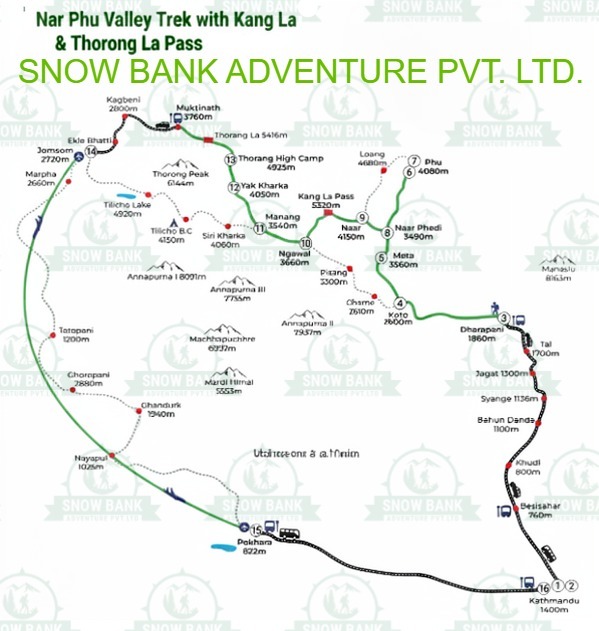
Trek Video
Packing List
- 4- Season Sleeping Bag
- Duffel Bag ( we will provide one complimentary Snow Bank Adventure duffel bag)
- Day pack
- Down jacket
- Upper Body- Head/ Ears/ Eyes: Sun hat, wool or synthetic hat that cover the ears, Sunglasses with UV protection, Head lamp and Neck warmer.
- Hand: Liner gloves and Heavier shell gloves
- Core Body: T- shirt, Light weight expedition thermal tops, fleece jacket or pullover, water/windproof of shell jacket ( preferably breathable fabric)
- Lower Body- Legs: Light weight expedition thermal bottoms, Nylon hiking shorts, soft shell and hard sell trekking pants, water/ windproof trousers, and casual pants.
- Feet: Liner socks, Heavy weight socks, water proof hiking / trekking boots.
- Gaiter ( for monsoon and winter)
- Medicines and first Aid kits: Including blister treatments ( moleskin), Pain relievers and personal medication.
- Miscellaneous but Important: water bottle/ bladder, water purification iodine tablets, Toiletry kit ( Be sure to include toilet paper, stored in plastic bag, hand wipes, liquid hand sanitizer, and towel)
TripAdvisor Reviews
FAQs
This is a challenging high-altitude trek and is best suited to experienced trekkers. The route includes the restricted Nar Phu Valley, Kang La Pass at 5,322m, Tilicho Lake at around 4,919m, and Thorong La Pass at 5,416m. Long walking days, steep climbs, high altitude, and basic accommodation make it considerably harder than the standard Annapurna Circuit.
Yes, previous high-altitude trekking experience is strongly recommended. This trek is not ideal as a first Himalayan trek because it involves two passes above 5,000m and extended periods at high altitude.
The highest point is Thorong La Pass at 5,416m. Kang La Pass reaches 5,322m, while Tilicho Lake sits at approximately 4,919m.
The itinerary is designed as a 16-day trek, including arrival and departure logistics, acclimatization days, the Nar Phu section, Kang La Pass, Tilicho Lake, Thorong La Pass, and the return journey to Kathmandu.
You need a Nar Phu Restricted Area Permit, an Annapurna Conservation Area Permit (ACAP), and a licensed guide for the restricted section. Permit arrangements are handled as part of the trekking package.
Yes. According to the current itinerary information, Nepal has removed the previous minimum-group requirement for restricted-area permits. Solo travelers can therefore undertake the route with a licensed guide.
Spring (March–May) and autumn (September–November) are the best seasons. These months generally provide more stable conditions and clearer mountain views, which is particularly important when crossing Kang La and Thorong La.
The Nar Phu section features traditional stone villages, Tibetan-influenced architecture, monasteries, chortens, mani walls, prayer flags, and mountain landscapes. Phu Village and Nar Village are the main cultural highlights.
Yes. Tilicho Lake is a central part of the itinerary. You trek to Tilicho Base Camp, hike to the lake at around 4,919m, and return to Base Camp before continuing toward the Thorong La section.
The route adds the restricted Nar Phu Valley, Kang La Pass, and Tilicho Lake before joining the standard circuit toward Thorong La. This makes it more remote, demanding, and culturally focused than the standard Annapurna Circuit.
Yes. Thorong La at 5,416m is the final major high-altitude crossing before descending toward Muktinath.
Accommodation is primarily in teahouses and basic mountain lodges. Facilities become simpler in the remote Nar Phu section compared with the more established Annapurna Circuit.
Most trekking days involve approximately 3–7 hours of walking, although the major pass-crossing days can be longer and more physically demanding.
Expect a mixture of steep mountain trails, narrow gorges, suspension bridges, rocky paths, high-altitude terrain, and long ascents and descents. Conditions can become more difficult around the high passes depending on weather and season.
Depending on weather and viewpoint, the route offers views of Annapurna II, Gangapurna, Tilicho Peak, Himlung Himal, and other peaks of the Annapurna region.
Yes. Nar Phu has a strong Tibetan Buddhist cultural influence, with traditional architecture, monasteries, prayer walls, chortens, and villages where farming and traditional mountain life remain important.
Yes. The itinerary includes an acclimatization day in Phu Village and another in Manang. These rest days are particularly important because of the elevation reached on Kang La, Tilicho Lake, and Thorong La.
It is not recommended for beginners. The combination of long trekking days, two 5,000m+ passes, high altitude, and remote terrain makes this route much better suited to experienced and physically fit trekkers.
You should bring suitable layered clothing, trekking boots, warm sleeping gear, gloves, a hat, sunglasses, sunscreen, a water bottle, personal medication, and essential trekking equipment. Your guide or trekking operator can provide a detailed packing list before departure.
Choose this route if you want a more remote and challenging Annapurna experience, combining the restricted Nar Phu Valley, Tibetan-influenced culture, Kang La Pass, Tilicho Lake, and the classic Thorong La crossing in one itinerary.