
Annapurna Base Camp Trek with Heli Return
-
Accommodation Hotel and Teahouse
-
Duration 5
-
Trip Difficulty Moderate
-
Activities Trekking/Adventure
-
Best Time Spring and Autumn
-
Max. Elevation ABC(4130m/13550ft)
-
Group Size Min-04 pax
-
Transportation Car/Jeep/Flight
-
Meals B L D During Trek
-
Start/End Pokhara to Pokhara
Overview
Not everyone wants to spend three or four extra days retracing the same trail after reaching Annapurna Base Camp. This tour lets you earn the climb into the heart of the Annapurna Sanctuary, then reward yourself with a helicopter flight back to Pokhara instead of walking out the way you came. It’s the same physical challenge and the same jaw-dropping arrival at Base Camp — just without the long walk back.
Over five days, you’ll trek from Pokhara through Jhinu Danda, Chhomrong, Dovan, and Deurali before reaching Annapurna Base Camp (4,130m), standing beneath Annapurna I (8,091m), Machhapuchhre, and Hiunchuli. Then, instead of turning around, you’ll board a helicopter and watch the entire Annapurna Sanctuary shrink beneath you on the flight back to Pokhara.
Why Choose This Tour?
- Trek to ABC, fly back by helicopter — get the full trekking experience up, then skip the multi-day walk down.
- Save 2-3 days of descent — more time for the rest of your trip, or just less time spent walking downhill.
- Incredible aerial views of the Annapurna Sanctuary — a totally different perspective on terrain you’ve just walked through.
- Less strain on knees and joints — descents are often harder on the body than climbs, and this cuts that out entirely.
- Perfect for travelers with limited time — reach Base Camp without needing two full weeks free.
- A luxury finish to a classic Himalayan trek — end the trip on a high note, literally.
- Avoid retracing the same trail — every day of this trek covers new ground.
- A memorable helicopter experience over the Himalayas — genuinely one of the more spectacular short flights in Nepal.
Who Is Annapurna Base Camp Trek With Heli Return Best For?
This trek is a great fit for:
- Travelers with limited vacation time, who still want the real Annapurna Base Camp experience.
- Couples looking for a premium, memorable finish to a shared trek.
- Photographers after aerial mountain views most ABC trekkers never get.
- Trekkers who want to avoid the long descent, whether for time, comfort, or simply not wanting to walk the same trail twice.
- Adventurers wanting the best of both worlds — real trekking, then real mountain sightseeing by air.
- Anyone looking for a more comfortable finish after the physical effort of reaching Base Camp.
Why Choose the Helicopter Return?
Instead of spending two or three days retracing the same trail back to Pokhara, you’ll board a helicopter directly from Annapurna Base Camp. The flight takes around 20-25 minutes and gives you sweeping aerial views of the Annapurna Sanctuary, its glaciers, deep valleys, and snow-covered peaks. It doesn’t just save travel time — it gives you a perspective on the Himalayas that most trekkers never get to see.
One moment you’ll be standing among the prayer flags at Annapurna Base Camp, surrounded by towering Himalayan peaks. Less than half an hour later, you’ll be looking back at the entire Annapurna Sanctuary from the air as Pokhara’s green hills come into view—a contrast few trekking itineraries can offer.
Why Travelers Love This Trek and What will you see from Helicopter?
Unlike the classic Annapurna Base Camp trek, this tour lets you feel the full satisfaction of reaching Base Camp without the long walk back out. Instead of retracing the same trail for several days, you’ll lift off by helicopter and watch the Annapurna Sanctuary unfold beneath you. For a lot of travelers, that flight ends up being just as memorable as the trek itself — it’s the kind of moment that gets talked about long after the trip is over.
And, As the helicopter lifts off from Annapurna Base Camp, you’ll fly above glaciers, moraines, alpine valleys, and the winding trekking trail you’ve just completed. On clear days, you’ll enjoy spectacular aerial views of Annapurna I, Machhapuchhre, Annapurna South, Hiunchuli, and the lush hills surrounding Pokhara. It’s a completely different perspective of the Himalayas that few trekkers ever experience.
Is the Helicopter Return Worth It?
If you’re short on time, yes. Instead of spending two or three days walking back down the same trail, you’ll take one of Nepal’s most scenic short flights and be back in Pokhara in under half an hour. It saves real time, cuts down on physical fatigue, and turns the end of the trek into a genuinely memorable experience rather than just a long walk home.
Very few trekkers ever see the Annapurna Sanctuary from above — this is one of Nepal’s most scenic helicopter routes, and it’s an ending that most ABC trekkers simply never get.
Trek Difficulty
The trekking days here are genuinely demanding — you’re covering the same distance as the standard route in fewer days, so expect long walking hours (5-7 hours most days) and real elevation gain. No technical climbing is involved, but solid fitness matters more here than on a longer, more gradual trek.
Altitude. You’ll reach 4,130m at Annapurna Base Camp after only a few days of ascent, so pay attention to how you’re feeling — drink water, pace yourself, and tell your guide if something feels off.
The helicopter is weather-dependent. Flights only operate in clear, stable conditions, so delays are possible, especially outside peak trekking season. Spring (March-May) and autumn (September-November) offer the most reliable flying weather; if a flight is delayed, most operators will rebook you or offer a refund rather than leave you stranded.
Group vs. private flights. Most helicopter returns run on a shared basis (up to about 5 passengers) at a lower cost, or you can charter the whole helicopter privately for more flexibility and schedule control.
Permits. You’ll need an Annapurna Conservation Area Permit (ACAP) and a licensed guide, both arranged as part of your booking.
If you’ve always dreamed of trekking to Annapurna Base Camp but don’t want to spend days retracing the same trail, this trek offers the perfect solution. You’ll experience the challenge, beauty, and achievement of reaching Base Camp on foot before ending your adventure with one of Nepal’s most spectacular helicopter flights—a fitting finale to an unforgettable Himalayan journey.
Outline Itinerary
Day 1: Jeep from Pokhara to Siwai, trek to Chhomrong (2,170m) via Jhinu Danda — 6-7 hrs
Day 2: Trek from Chhomrong to Bamboo (2,310m) — 5-6 hrs
Day 3: Trek from Bamboo to Deurali (3,230m) — 4-5 hrs
Day 4: Trek from Deurali to Annapurna Base Camp (4,130m) via Machhapuchhre Base Camp (3,700m) — 5-6 hrs
Day 5: Annapurna Base Camp to Pokhara by helicopter — approx. 20-25 min flight
Detailed Itinerary
Day 01: Pokhara to Chhomrong (2,170m/7,120ft): 6-7 hours
Start our trip from Pokhara, the excellent lake city. We drive to Jhinu danda vai Nayapul (3 to 4 hours) and begin the trek, from Jhinudanda to chhomrong (2-3 hrs), a lovely village for the most part possessed by the Gurung people group. Chhomrong is a lovely Village situated on the lap of the goliath Annapurna.
- Accommodation: Overnight at teahouse
- Meals: L, D
Day 02: Chhomrong to Bamboo (2,310m/7,578ft): 5-6 hours
We drop through 2,500 steps and cross the scaffold above Chhomrong Khola. From here it is a tough move to Sinuwa. Next, we go through wonderful woodland to Kuldihar pursued by a simple downhill stroll to Bamboo.
- Accommodation: Overnight at teahouse
- Meals: B, L, D
Day 03: Bamboo to Deurali (3,230m/10,595ft): 4-5 hours
We go through bamboo backwoods to achieve Himalaya where the timberland opens up and we are out in the sun again with dumbfounding perspectives on the frigid stream underneath. It is a lofty move up through a lot of drier woodland before coming to Hinku Cave. From here we can see the trail drop nearer to the stream before climbing again to Deurali, the most picturesque stretch of the day.
- Accommodation: Overnight at teahouse
- Meals: B L D
Day 04: Deurali to Annapurna Base Camp (4,130m/13,545ft) by means of Machhapuchhre Base Camp (3,700m/12,135ft): 5-6 hours
The climb from Deurali to Machhapuchhre Base Camp is fairly strenuous. From Machhapuchhre base camp, we get brilliant perspectives on the lofty Machhapuchhre alongside Mt. Hiunchuli, Annapurna South, Annapurna I, Annapurna III, Gandharvachuli, and Gangapurna which is surely a compensating background. The vegetation vanishes on our approach to ABC and the way broadens as we enter the Annapurna haven. From here, we get thrilling perspectives on the close vertical south face of Annapurna transcending above us. The haven brags of a dynamic view without anything hindering the 360-degree display.
Accommodation: Overnight at teahouse
Meals: B L D
Day 05: Annapurna Base Camp to Pokhara via helicopter : 20 Min flying duration
From the Annapurna base camp, we backtrack but we directly flying from ABC to Pokhara.
- Accommodation: None
- Meals: B
Includes & Excludes
Includes
- Private Jeep transportation from Pokhara to Jhinu-danda and Pokhara airport to Hotel and Heli from ABC to Pokhara
- Farewell dinner in Kathmandu Nepali cultural restaurant.
- Transportation from the starting and ending point of trekking by private vehicle
- Three meals and tea, coffee during the trek
- Safe drinking water (treated with chlorine and iodine)
- Permit of the trek (TIMS, Conservation, and National-park fee) for foreigner
- All types of necessary government paperwork and government taxes
- Guide and Porter (meals, wages, Insurance & transportation)
- An English-speaking government registered trekking guide and Porter (1 porter for 2guest)
- Trekking equipment like a raincoat, sleeping bag, down jacket, and walking
Excludes
- Personal expenses
- Personal & medical insurance
- Rescue evacuation Insurance
- Beverage and Bar bills (soft drinks, hard drinks, and mineral water) Boiled water
- Electronic devise recharge
- Wi-fi during the trek
- Tips for Guide and Porter
Trek Route Map
Download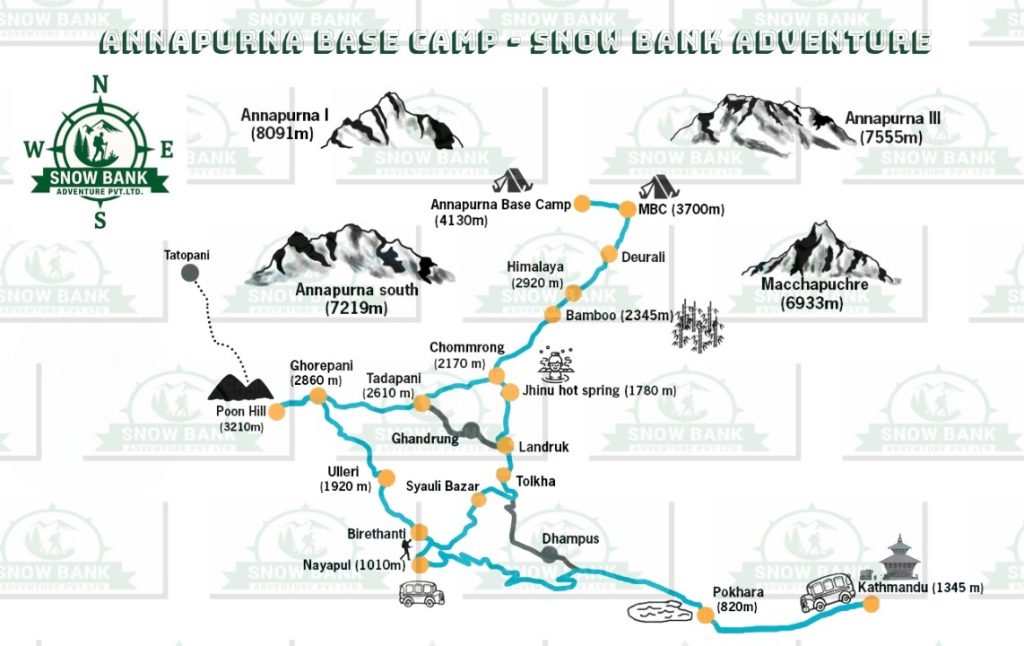
Packing List
- Duffel Bag ( 25 kg): Provided during the briefing in Kathmandu. It is durable and waterproof and porters will carry it throughout the trek.
- Daypack with Rain Cover ( 25-30L): Choose one with good back support and adjustable straps. It should hold your daily essentials like a Jackets, water, snacks, sunscreen, gloves, a camera, and important documents.
- Sleeping Bag ( -10°C to -15°C): A high - quality sleeping bag is included at no extra cost. Suitable for colder places.
- Down Jacket ( -10°C to -15°C): Supplied by us. It is warm, insulated, and comes with a hood- perfect for chilly morning and evening.
- Trekking Poles: Helpful for maintain balance, and reducing strain on joints, especially on steep trails like ulleri, chomrong, and the descent to jhinu Danda.
- Water Bottle ( 1-2L): Can be refilled daily. We suggest using a Nalgene bottle or a 2-3l hydration bladder with a tube for convenience.
- Headlamp + Spare Batteries: Necessary for early starts, Power outages and pre-dawn hikes
- Travel Adapter ( Type C,D,M): Nepal uses different plug types so a universal adapter with USB ports is recommend
- Dry Bags / Zip Locks (3-4): Use to protect clothes, electronics, and toiletries from moisture. Large Plastic bags also work well in wet seasons.
TripAdvisor Reviews
FAQs
The average temperature of Annapurna Base Camp is around 5°C. Mostly, the base camp is always cold, so you need warm cloths to keep yourself comfortable and warm. The lowest temperate recorded is -20°C during the winter season. The warmest temperate was around 15°C during the summer. Overall, keep in mind it is always cold.
Trekking in Nepal is not an easy task. However, Annapurna Base Camp is a moderate to difficult level trek that anyone can enjoy. The trail goes through the forest, hills downs. Some sections of the trail involve ascending and descending on a stone path. So, you must be well prepared to cope with such difficulties during the trek. You need to do physical fitness training a few months before your trip starts.
The highest point is around 4,130 meters, so there is less chance of getting altitude sickness. The also makes the trail an ideal starting point for beginners. We have tips for beginner trekkers. Make sure to check them.
As mentioned above, Annapurna Base Camp is a moderate trek. This trek is not as strenuous as other trekking routes. But if you area beginners, you should be physically fit enough to be able to walk 5-6 hours every day.
Altitude sickness, known as acute mountain sickness (AMS), is a sickness that usually occurs at high altitudes due to low oxygen levels and low atmospheric pressure. The symptoms of altitude sickness are headache, loss of appetite, nausea, fatigue, and so on.
Annapurna sanctuary does not take a high altitudes like other trekking routes, but you should be concerned about altitude sickness, most trekkers can still digest high altitudes, but prevention is better than cure.
Good news, you can prevent altitude sickness. The best way to fight back is acclimatization. Eat enough carbohydrates and stay hydrated. Incase are not feeling well, you can take Diamox tablets too.
Electricity is available throughout the route even in ABC. Nowadays, teahouses do not charge money for charging devices. Furthermore, charging plugs are available in every room.
But in upper settlements, charging parts are only available in the dining hall. Therefore, you might stay in the queue to charge your devices. It is better to carry a power bank just in case.
Likewise, Wi-fi is available all around the route. Tea houses charge USD 1 to USD 4, depending on the place you are staying. It is not fast enough because everyone will be using the same wi-fi but is ready to go.
No, you do not need guide and porters to trek to Annapurna Base Camp. Anyone can travel in the Annapurna region without the need for additional assistance. It is a paradise for solo travelers.
However, we highly recommend hiring a guide and porter. You can understand the culture and history of Nepal even better. In addition, a porter can help carry all your stuff.
Bring layered clothing ( fleece, down jacket), comfortable trekking boots, a steeping bag, and reusable water filter.
It is recommended to use water purification tablets or a filter, as bottled water is expensive and generates plastic waste.
Basic medical care is available in lower villages.
Winter at Annapurna Base Camp brings regular snowfall. Actually, December to February often sees heavy snow above 3,500m. Moreover, trails may be teahouse less crowded. Likewise, cold winds increase the chill factor our. Company, Snow Bank Adventure monitors trail conditions and informs clients departure.
Similarly, we equip our guides with up-to-date weather reports.
Autumn offers the clearest sunrise and sunset views on the ABC trek. Actually, September to November brings dry skies and stable weather. Move ever the crisp and mountains look very close.