


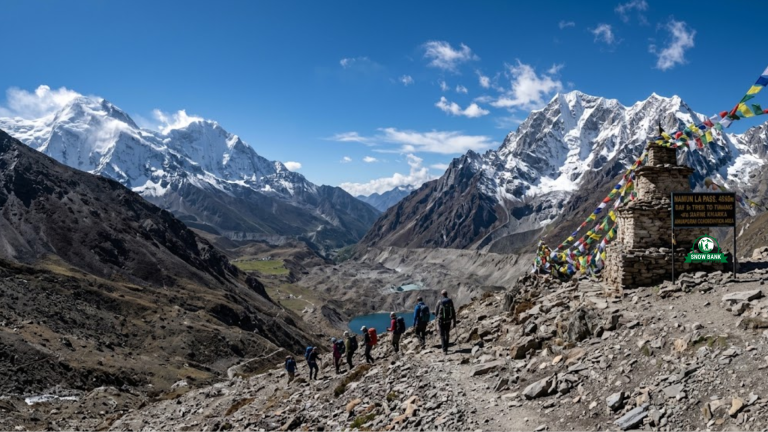
Namun La Pass Trek- 10 days
US $$1,140

Manjushree Lake sits at about 4,850 m above the Lapchi Valley, a remote pocket of Dolakha close to the Tibetan border. Few trekkers ever see it. Lapchi is a place of pilgrimage where Guru Milarepa is said to have meditated, and where monks still come to practise in caves and hermitages.
Over eight days you travel up the Tamakoshi gorge from Kathmandu to Lamabagar, then walk through Lumnang, the winter village of the Lapchi community, to the monastery at Lapchi. Two nights at 3,670 m with a gentle acclimatization hike give your body time to adjust before the long day up to the lake. Expect basic tea house lodging, few other trekkers and a trail shaped as much by culture as by scenery.
The trek suits fit walkers who want a remote route with Buddhist heritage, village life and a real high-altitude day, without the crowds of the main trekking regions.
If you are fascinated by Buddhist culture and traditional Himalayan communities, you may also enjoy our Manaslu Tsum Valley Trek, which takes you through remote settlements, ancient monasteries and culturally rich mountain landscapes.
Spring (March–May) brings stable weather, clearer mornings and rhododendron on the lower slopes. Autumn (October–November) usually gives the clearest skies and the most reliable conditions for the lake day.
Monsoon (June–September) brings heavy rain, leeches, and a higher risk of landslides on the road and trail. Winter (December–February) is cold, with snow likely above Lapchi, and the lake may be inaccessible. Because the Lapchi community moves between Lumnang and Lapchi with the seasons, lodge availability varies, so we confirm lodging before each departure.
For travelers interested in exploring more remote Himalayan destinations, our Kang La Pass and Thorong La Pass Trek offers another incredible opportunity to experience Nepal’s spectacular mountain landscapes and high-altitude trekking routes.
This is a moderate to strenuous trek. The route is remote, the trail is rugged, and the final lake day reaches nearly 4,850 m. You do not need technical climbing skills, but you do need good fitness and a positive attitude.
Lapchi lies within the Gaurishankar Conservation Area and close to the border, so permits are required. We arrange them for you.
To process permits we need a clear copy of your passport, passport-size photos, and your arrival details at least 7 to 10 days before departure. Permit fees are [included in / paid on top of] the trip price.
Lodging on the trail is simple. Expect basic tea houses and local guesthouses in Lamabagar, Lumnang and Lapchi, with a hotel in Charikot on Day 7.
Breakfast, lunch and dinner are included on trek days. Meals are cooked in the tea houses and are plain, hearty and made for trekkers.
| Day | Route | Elevation | Time | Overnight |
|---|---|---|---|---|
| 01 | Drive: Kathmandu – Charikot – Lamabagar | 1,400 m → ~2,000 m | 7–8 hrs drive | Tea house, Lamabagar |
| 02 | Jeep / trek: Lamabagar – Lumnang | ~2,000 m → ~2,800 m | 4–5 hrs (jeep + walking) | Tea house, Lumnang |
| 03 | Trek: Lumnang – Lapchi; Choro Gephel Ling Monastery | ~2,800 m → 3,670 m | 4–5 hrs trek | Tea house, Lapchi |
| 04 | Hike: Lapchi – Rechen Cave and heritage sites | 3,670 m → 3,950 m | 3–4 hrs round trip | Tea house, Lapchi |
| 05 | Excursion: Lapchi – Manjushree Lake – Sephuk Cave – Lapchi | 3,670 m → 4,850 m | 7–8 hrs round trip | Tea house, Lapchi |
| 06 | Trek: Lapchi – Lumnang | 3,670 m → ~2,800 m | 4–5 hrs trek | Tea house, Lumnang |
| 07 | Trek + drive: Lumnang – Lamabagar – Charikot | ~2,800 m → ~2,000 m | 4 hrs trek + 2 hrs drive | Hotel, Charikot |
| 08 | Drive: Charikot – Kathmandu | ~2,000 m → 1,400 m | 5–6 hrs drive | None |
Nepal is home to many incredible trekking destinations beyond the popular trails. Explore our Annapurna Region trekking packages to discover more unforgettable Himalayan adventures.
After breakfast we leave Kathmandu and climb out of the valley through Dhulikhel and Mude, then drop towards Charikot, the district centre of Dolakha. If time allows, we stop to see the Bhimsen Temple in Charikot. Beyond Singati the road follows the Tamakoshi River into the narrow upper gorge, where the valley walls close in and the road becomes rougher before reaching Lamabagar, the last road-head town before the trek.
Lamabagar is a small Sherpa settlement. We settle into our tea house, meet the trekking crew and check gear for the days ahead.
The real journey begins. We follow the rugged track beside the Tamakoshi, using a local jeep on the sections where the road is open and walking the rest. The trail passes through forested hillsides, small settlements and river crossings, gaining about 800 m as the valley narrows.
Lumnang is the winter village of the Lapchi community, who move between here and Lapchi with the seasons. Expect simple lodging and a first taste of the region's Tibetan Buddhist culture.
Today is a steady climb of roughly 870 m. The trail rises through forest into juniper and alpine scrub, past yak pastures, prayer flags, mani walls and chortens that mark the approach to a pilgrimage valley.
On arrival in Lapchi we visit Choro Gephel Ling Monastery, a spiritual centre associated with the Tibetan Buddhist master Guru Milarepa. This is our base for the next three nights, so take the afternoon slowly and let your body adjust.
A short day with a purpose. We hike up to Milarepa's Rechen Cave, a meditation site tied to Guru Milarepa, and visit nearby caves, hermitages and viewpoints beneath the rocky cliffs above the village. The pace is gentle and the gain is modest: climb high, then sleep low.
This is a deliberate rest day for Manjushree Lake. Your guide will check how everyone is feeling, and the lake day only goes ahead if the group is acclimatizing well.
This is the day the trek is built around. We start early and climb through high alpine terrain, rocky slopes and mountain pasture, with a gain of roughly 1,180 m to the lake at about 4,850 m. We spend time at the turquoise water and visit Sephuk Cave, another sacred site in the Lapchi area, before retracing our route to the village.
It is a long, demanding day at altitude. Timing, route and the decision to go to the lake depend on weather, trail conditions and your guide's assessment of the group. Carry water, snacks, warm layers and a rain jacket.
After breakfast we say goodbye to Lapchi and head back down the way we came. The air thickens with every step as juniper gives way to forest. With the altitude behind us, you can pay more attention to the villages and views you passed on the way up.
The descent is steep in places and can be hard on the knees, so trekking poles are worth having.
We walk the final stretch of trail beside the Tamakoshi to Lamabagar, where our vehicle is waiting. From there we drive down the gorge to Charikot and check into a hotel, with a proper room and a chance to relax after the trek.
After breakfast we drive back through the hills of Dolakha and Kavrepalanchok, across terraced farmland and river valleys, and arrive in Kathmandu in the afternoon. Your trek ends on arrival, with a transfer to your hotel.
Elevations, distances and durations are approximate. The itinerary may change with weather, road and trail conditions, and the group's health.
Provided by us: sleeping bag, fleece liner, pillow, down jacket, duffle bag and trek map.
No technical skills are needed, but you should be fit and comfortable walking for several hours a day. Previous experience at altitude is helpful.
The highest point is Manjushree Lake at about 4,850 m on Day 5. The highest overnight stay is Lapchi at 3,670 m.
The lake day depends on weather, trail conditions and how the group is feeling. If we cannot reach the lake, your guide will offer an alternative day around Lapchi.
Both are limited. Charging is sometimes available at tea houses for a fee, and signal is patchy or absent. Bring a power bank.
Yes. Private departures can be arranged for individuals, couples, families and small groups. Contact us for details.
Vegetarian food is widely available. Tell us about any other dietary needs when you book.
Yes. Your policy must cover trekking to at least 5,000 m, medical expenses and emergency helicopter evacuation.
Fit older trekkers in good health can do it. Children and anyone with heart or lung conditions should check with a doctor first. Contact us to discuss.

